Motion graphics video maker: movement is cheap, timing is the craft
Most tools that call themselves a motion graphics video maker are selling you movement, and movement is not the craft — timing is. Anything can move. What moves, when and how fast is the job. Motion design has been my job for about fifteen years. Here's the craft itself, and an honest read on every route to getting it made.
What motion graphics means when the product is software
For a software product it's almost never a screen recording. It's your interface rebuilt as vector layers that survive a phone, type doing most of the acting, and a few shapes standing in for things with no picture — a queue, a sync, a permission. No characters, no 3D, no stock.
It suits software because software is invisible.
You can shoot someone looking at a laptop, but not what the laptop is doing, which is the only part anyone cares about. A camera points at the user, never at the process.
Motion points at the process. It compresses three weeks of manual work into four seconds without lying about it, holds a before and an after in one frame the way no camera can, draws a sync as a line between two systems so you know they talk to each other. In time, in the order it happens, at the speed you choose.
What a motion designer is deciding
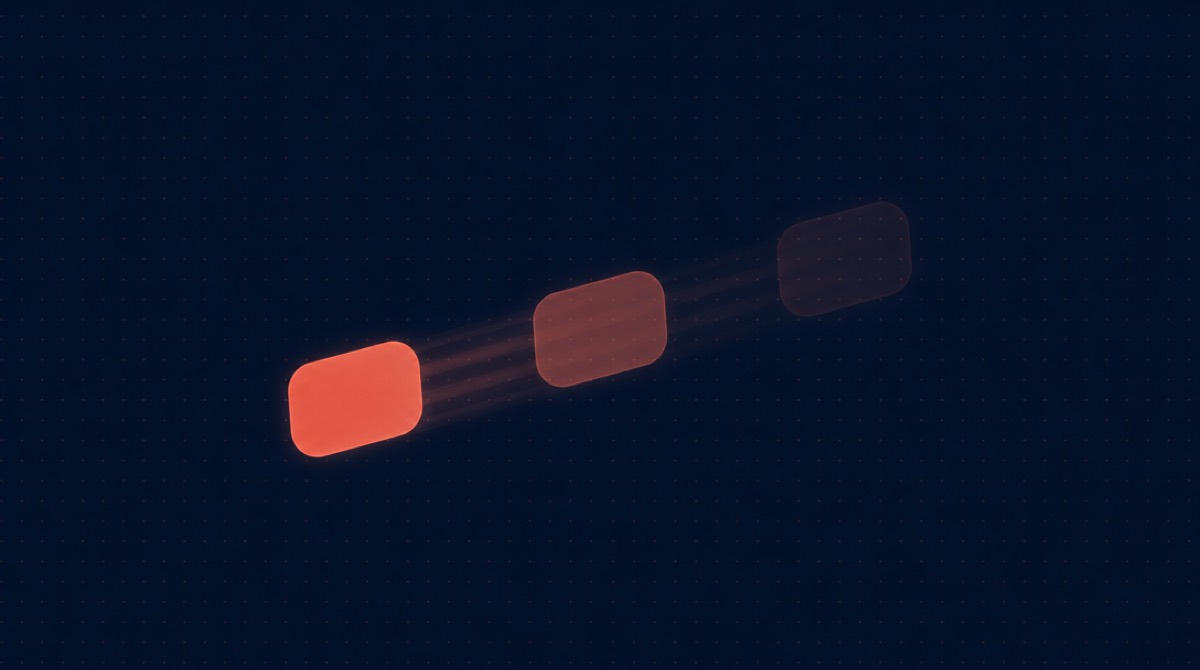
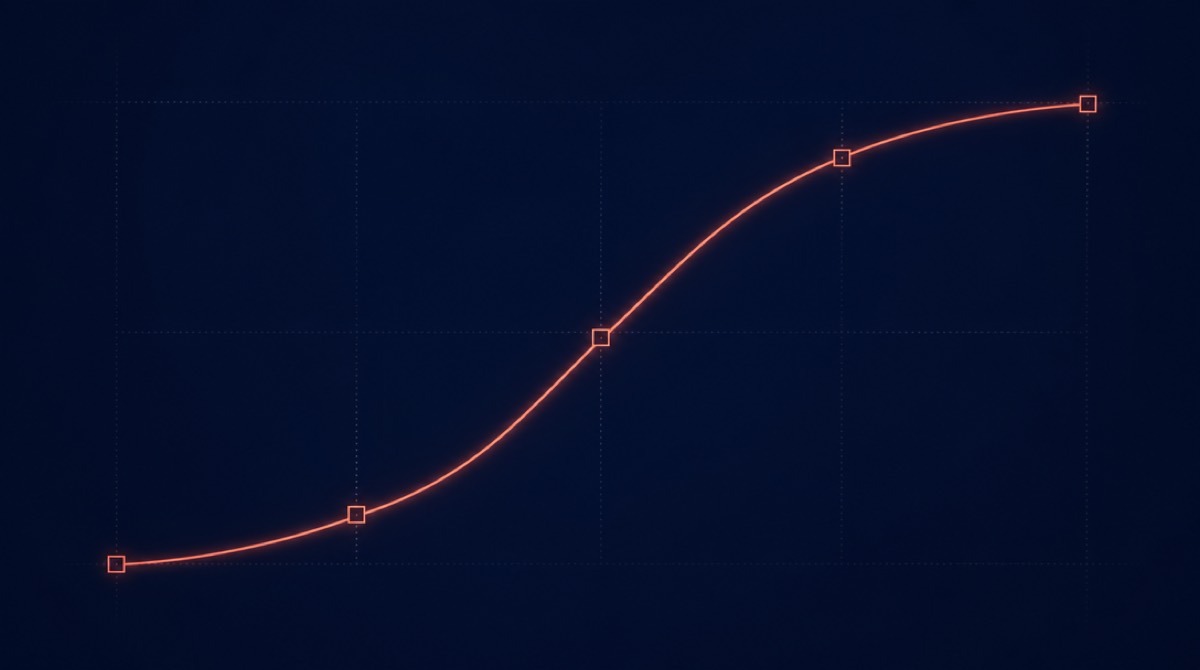
Easing is the first tell. Linear motion — constant speed from A to B — reads as cheap to nearly everyone I've shown it to, and none of them can say why. Nothing physical moves that way: things have mass, so they accelerate and settle. Entrances want to be front-loaded: most of the distance in the first third, then a decelerating settle. Exits want the reverse. Keep both quick, because a card moving 40 pixels doesn't need 800ms, it needs about 250. Overshoot is a taste decision wearing technical clothes: a settle that bounces past its mark reads playful, right for a consumer app and wrong for anything selling security or money. I thought this was all taste until I rendered one entrance linear, then with an exponential ease-out, and watched them back to back.
Blur is the second tell. Film smears between frames; a browser doesn't. A perfectly eased move with no motion blur still reads as a web animation, not something photographed, and that's part of what people mean by cheap. My own pipeline has that limit, so I'll say it rather than bury it: HTML, CSS and GSAP in a browser gives no true per-frame blur, and you compensate with discipline — shorter travel, tighter durations, fewer fast moves.
Holds are where the reading happens. You cannot read moving text: the eye tracks the object instead of parsing the glyphs, so the animation is delivery and the still moment afterwards is the message. On-screen copy sits still for as long as it takes to say out loud, plus a beat. Newer animators clip that hold because the timeline looks empty.
The timeline is not the audience.
Stagger is grammar. The gap between three cards arriving decides what they mean:
- All at once: one thing, in no particular order.
- 70ms apart: one thing, read them in this order.
- 300ms apart: three separate events that share a scene.
Exits matter and almost nobody animates them. An exit says whether the idea finished or got interrupted, and it wants to be faster than its entrance — around two-thirds the duration, because nobody studies something that's leaving. Direction carries meaning: an element exiting left as the next enters from the right reads as progression, everything dissolving in place reads as a slideshow.
One thing owns the frame at a time. When two elements move the eye picks one and you don't get to choose which. Hierarchy in motion is a question of who is permitted to move right now, and holding everything else still feels wrong on the timeline and correct on playback.
And the movement has to carry the sentence. A push-in works only if it lands on the word the line is built around: start it on the stressed syllable, settle before the phrase ends. Two hundred milliseconds late and it reads as a camera catching up with the script. The version I see most is background parallax, drifting behind the copy for the whole runtime, through a sentence it has nothing to do with. Continuous motion tells you nothing, because nothing ever changed.
I over-animated for years and was proud of it. There's a logo build in my old reel that runs ninety frames and six easing curves to arrive at a static mark. What corrected me wasn't feedback. It was sitting beside someone watching a piece of mine for the first time, at their speed, and being asked what the middle section had said. It was up for under a second and I had read it two hundred times. Every hold in my work was timed by the one person who already knew the answer.
Watch that twice: once following only the exits, where each element goes when it's finished and whether it hands off or just vanishes; once pausing at three random moments to count what's moving. Both passes work on your own explainer video.
The four ways to get it made
The cost comparison is in agency vs freelancer vs AI. This is the craft version.
Learn After Effects yourself. The software is learnable in a few weeks; the timing judgement is the multi-year part, because you learn holds by watching your own work fail in front of someone. The cost that surprises people is rebuilding at 9:16: elements that sat side by side have to stack, and stacking re-times everything — what arrived together now needs a stagger, every hold gets longer because the eye travels further.
Template marketplaces. The template smell is a timing problem before it's a visual one. Restyle the colours, swap the typeface, and scene three is still four seconds long whether your third sentence needs two seconds or seven. Open one and look at the text layers: if the copy is still moving when the next scene starts, there are no holds in there, and that's the part you can't fix by typing over the placeholder.
Hire a motion designer or a studio. Still the ceiling, and three to six weeks of it. Most of what you pay for happens in week one, off the invoice: style frames, and a decision about how the brand moves — one family of easing curves, one transition vocabulary — settled before a scene is animated. You can spot a senior timeline because the same transition never turns up doing two different jobs. More on studio work in the examples post.
AI that designs each frame rather than filling a preset. Obvious stake here. The question is whether the system picks a layout off a shelf or composes the frame around your script. How to tell, from the output rather than the marketing, is its own post. Ours authors each video in HTML, CSS and GSAP per script, so easing curves, stagger values and hold lengths are decided scene by scene, not inherited from a slot. I built PromoHyper because that judgement used to cost five figures and six weeks; it starts at $29, everything before the render is free, and your first video is free to render outright if you don't mind our watermark sitting on it.
Look past the brand and watch the timing. The holds run long enough to read on a first watch and the text lands with the voice instead of trailing it. What it doesn't have is a risk. Nobody decided this piece would live or die on one idea, because a system won't reach for that unprompted, so what comes out is right rather than memorable. The other limits are structural: nothing with a human being in the frame — no shoot, no presenter, no synthetic stand-in for one. If your idea needs a person in it, I'd rather you knew before you paid.
When an agency is still the right call

The motion graphics agency alternative isn't always the right answer. Hire a studio when the concept has to be invented: one visual metaphor holding a whole film together, a bespoke type build, the decision to sit on a single shot for eight seconds while the room wants to cut. Hire one for a brand film, or for a motion system your team will apply for years. When the piece has a shelf life measured in months, you're buying clarity against a deadline, which is a different purchase.
Whichever route you take, the yardstick doesn't move. The checklist I hold every promo to is clarity, timing and restraint, and not one line of it costs money. The test I'd add for motion: watch it once and write down the order you read things in, first and second in each scene, then compare that against the order you intended. Everywhere the two disagree, something moved that shouldn't have, and no budget fixes that for you.