Turn your blog posts into video: the ones you're writing aren't being read
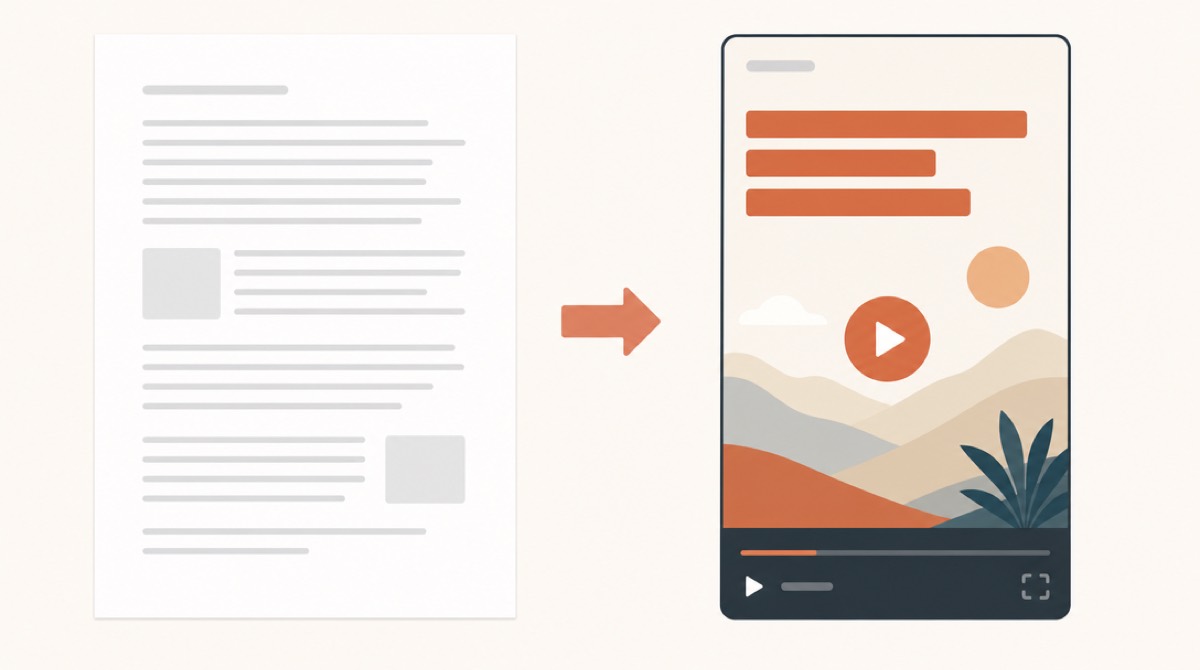
Everyone with a SaaS is writing blog posts for SEO right now, and most of them are written by a language model. I do it too. This is a post about the part nobody checks afterwards, which is whether any of it gets read.
I checked mine. It was not a good afternoon.
What I found when I looked at my own blog
At the time I ran the numbers, this site had 46 pages that I wanted in Google. Eleven were indexed. Thirty-one had never been crawled at all — not ranked badly, not buried on page nine. Never fetched. Google had not spent the request.
I want to be precise about why that matters, because "my SEO isn't working" is the wrong lesson. A page that ranks badly is in a competition. A page that was never crawled isn't in the competition. It's a file on a server. Everything I put into those thirty-one posts — the research, the angle, the edit pass — was spent on something that no reader has ever had the opportunity to skip.
And I'd been measuring the wrong thing for weeks. I was looking at rankings and thinking about keywords, when the actual constraint was one step earlier and much dumber: crawl budget.
Writing became free, so everyone writes more

Here's the arithmetic that's changed under all of us.
Producing a competent 1,200-word post used to cost either an afternoon or a freelancer. That cost was doing quiet work: it capped how much anyone published, which kept the total volume of new pages roughly within what search engines were willing to fetch.
That cap is gone. A post now costs a few cents and about ninety seconds. Every SaaS founder I know discovered this at roughly the same time and responded the same way, which was to publish more. I did the same thing.
Nothing on the other side of that scaled. Google's willingness to crawl a small site did not triple because small sites started producing three times as much. So the marginal post doesn't just fail to earn attention — it competes with your own earlier pages for a fixed and fairly small number of fetches.
That's the trap of AI-written SEO content. It isn't that the writing is bad. Mine isn't bad. It's that the strategy assumed a bottleneck that moved.
Reading is the expensive thing now

I'll be careful here, because this is where marketing posts usually invent a statistic. I don't have one, and I'm not going to make one up.
What I'll say instead is what I can observe in my own behaviour and in the behaviour of everyone I've built video for over fifteen years. When something arrives as text, I decide whether to read it. That decision costs effort, and I usually decide no. When the same thing arrives as a video that's already moving, I don't make a decision at all. I just watch, and I stop when I'm bored.
That asymmetry is the whole thing. Text asks for a commitment before it gives you anything. Video gives you something first and asks later.
It doesn't make video better than writing. Some of what I know I only know because I read it slowly. But it does mean the same argument, in the same words, reaches a different number of people depending on which shape it arrives in — and right now the text shape is the crowded one.
A blog post is already a script
The useful realisation is that you don't need new material for this. You already made it.
A blog post that's worth anything has the three things a short video needs: a claim, some structure underneath it, and a place it ends up. That's a script. It's a script with the wrong formatting and about four times too many words, but the thinking is done, and the thinking is the part that's hard.
What's left is genuinely mechanical — cutting 1,200 words to roughly 150, finding the two or three beats that carry the argument, deciding what's on screen while each sentence is spoken. That work is real, but it's the kind of work a machine can now do acceptably, which was not true two years ago.
So the sensible move isn't to stop writing. It's to stop letting the post be the only shape the idea ever takes.
What we built for this
PromoHyper does this now. You paste the URL of a blog post and it reads the post, works out the argument, and writes three different short scripts from it — three genuinely different angles, not three rewordings. That takes about seven seconds and it doesn't cost anything, because you should see the thing before you decide whether it's worth paying for.
You pick the one that sounds like you. It then produces a vertical video: voiceover, motion graphics built around your actual product and brand, music if you want it. The videos we've measured come out around seventy seconds, which is the length where a single argument fits and an audience is still there at the end.
The output is designed for the places a blog post can't go — the vertical feeds where nobody is going to click through to read 1,200 words, but where seventy seconds of a clear argument does fine.
Where this doesn't work

I'd rather say this than have you find out.
Some posts should not become videos. Reference material is the obvious one — pricing tables, API documentation, anything a reader scans and returns to. Video is the worst possible shape for something you need to look things up in. The same goes for posts whose value is a long list, or code, or a table you need to compare across rows. Turning those into a voiceover destroys the thing that made them useful.
The posts this works on are the argumentative ones. A post with an opinion, a comparison, a story about something that went wrong, a "here's how we think about X" — anything you'd be willing to say out loud to someone. If you'd say it out loud, it converts. If you'd only ever hand it to someone on paper, leave it on paper.
And one more, honestly: this doesn't rescue a post that had nothing to say. A thin post becomes a thin video, and a thin video is more obviously thin, because nobody can skim past the weak part. It's a distribution fix, not a quality fix.
The short version
Publishing more text into a channel that isn't fetching your text is not a strategy, and I say that as someone who spent months doing exactly that.
The writing you've already paid for is fine. The argument in it is fine. It's just sitting in the one format that everybody's flooding right now, and it takes about seven seconds to find out what it sounds like in a different one.