A SaaS launch strategy is mostly a scheduling problem
You get one day where strangers look at your product on purpose. Not because they need it. Because someone put it in front of them. Cold attention, concentrated into a few hours, then it's over and you're back to writing emails one at a time.
So the useful question isn't how to get attention. It's what you have ready when it turns up. Most of what people call a SaaS launch strategy is a list of assets and a calendar, and the calendar is the part that goes wrong.
I've spent 15 years making promo and product videos, a lot of them aimed at a launch date. The pattern I keep seeing: months of building, one afternoon of explaining. Then launch day arrives and the explaining is the only part anyone experiences.
One caveat before I hand out advice: I don't run launches. I make the thing that goes in them, so I've watched a lot from one seat over. Treat the next two sections as an outsider's pattern-matching.
Pick one surface. Really, one.
The instinct is to do everything at once. Product Hunt, Show HN, LinkedIn, X, the newsletter, three subreddits, all on a Tuesday. It feels efficient. It isn't. Each place wants a different tone and a different first sentence, and posting to five means monitoring five comment sections badly instead of one properly.
Product Hunt rewards a strong visual and a founder who answers every comment fast. Everyone who has launched there will tell you the first hour decides the day. I've never seen inside the ranking, but the regulars act as though that's true.
Show HN punishes marketing language harder than any surface I know. Write it like a technical note to a peer: what it does, and what it doesn't do yet. If it reads like a press release, expect the top comment to be about that.
LinkedIn is where your network already is, the surface where "I built a thing and here's what broke" travels best. Lower ceiling, warmer floor.
Your email list is the only one you own. Say 300 people asked to hear from you. I'd take those 300 over a Product Hunt slot on a busy day, and nobody wants to hear that.
Pick the one where your buyers already are. Do the rest as follow-ups over the next week, rewritten each time, not pasted.
Most of a SaaS launch strategy happens the day before
This is the boring section and it decides how the day goes.
By the night before: copy written and read out loud once. Images exported. The video rendered in every aspect ratio you'll need. A pricing page that doesn't say "coming soon", and a way for someone to pay you.
And someone other than you who has tried signing up on a phone. That's the one I'd check first, and the one I've most often seen skipped. You've tested your own signup a hundred times on a desktop with the password autofilled. You have no idea what it feels like cold, one thumb.
Write your first comment in advance too. You get one comment from yourself near the top, and composing it at 6am while refreshing a leaderboard is a bad way to produce good sentences.
The first hour
Answer every comment. Not with "thanks!" but with an answer containing information. Someone asks whether it handles X: say yes and how, or say no and when. I read comments to work out whether the founder is serious, and precise answers are what tell me.
Don't ask friends to post enthusiasm. When I see "wow, love this, so useful!" from an account with no history, I start reading every other comment as suspect. I doubt I'm the only one.
Do tell people who already use the thing that today is the day. That isn't gaming anything.
Why a video usually beats a screenshot at the top of the page
Now the part I actually know something about.
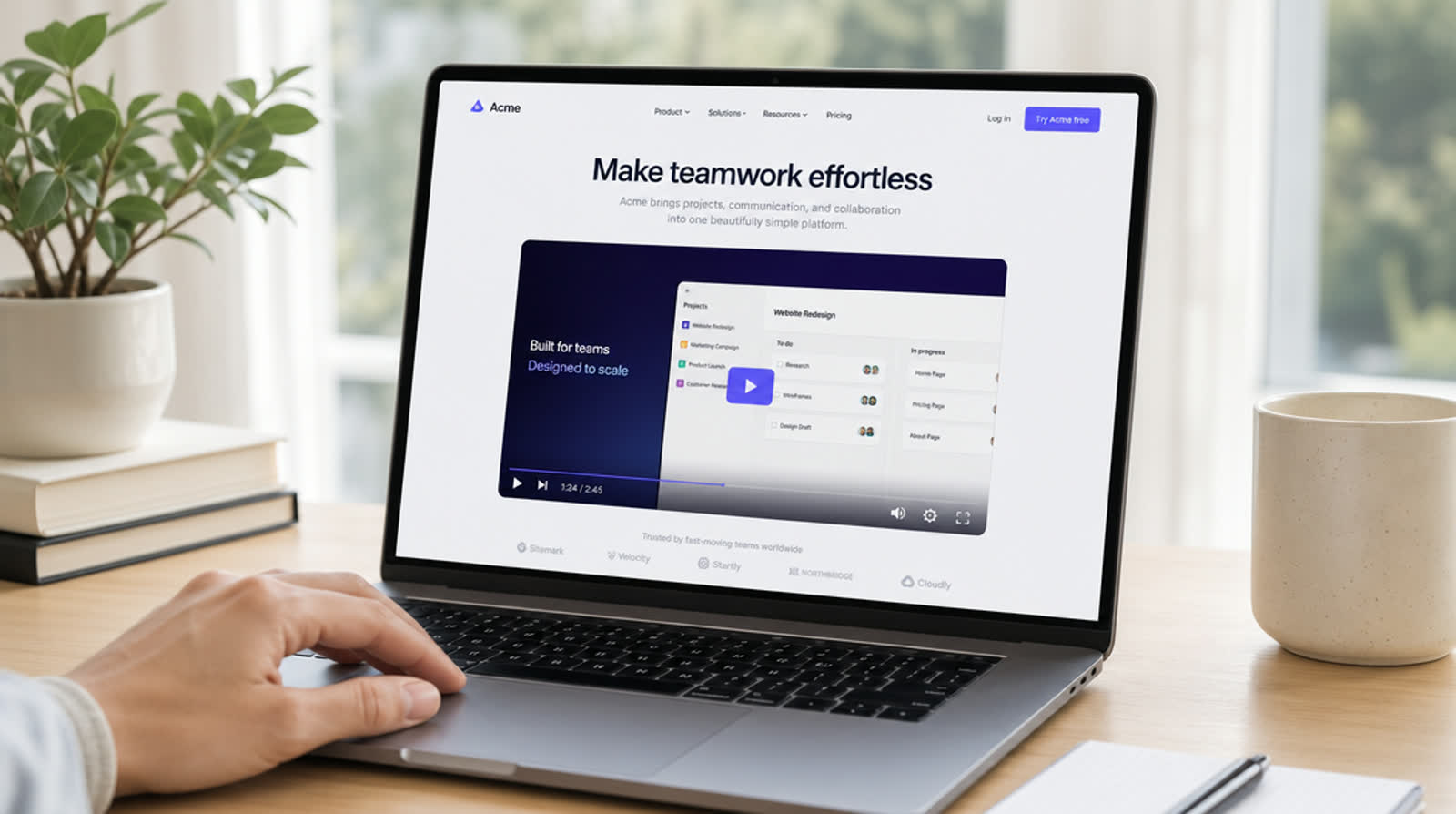
A launch page is the worst reading environment on the internet. Assume the visitor is skimming and assume they're fast. A screenshot asks them to work: look at the interface, infer the workflow, imagine the problem it solves, decide whether that's their problem. Four things you're asking of a stranger before they know whether they care.
A short video does that work for them. It shows the problem, then the product handling it. And it has a voice, which I think is underrated: a voice implies a person made this, and that does quiet trust work on a page full of anonymous SaaS.
Being honest, since this is my business: a video doesn't save a bad launch. It won't fix an unclear product or a page that hides the price. I think it changes a launch page more than any other single asset, and I'd say that even if I didn't sell them, but it's one of maybe six things that matter.
Things I'd argue about:
Front-load. My rule is that the first five seconds show the product doing its actual job. Not your logo. I got this wrong for years: I opened videos with a logo animation because it made the work feel finished, and because clients liked watching their mark move. It's a cost you pay in the seconds you can least afford. The logo belongs at the end, as a signature.
Make it work muted. I assume the first view is silent, because mine usually is. So mute your own video and watch it. If you can't follow it, a stranger who cares less than you won't either. That means real captions, timed tight to the voice. Push them three frames late and play it back: I can't always name what's wrong when someone else does it, but I stop trusting the video.
Cut the slow zoom on the dashboard. A five-second push-in on a screen with no explanation is furniture. If a shot isn't answering a question the viewer already has, it shouldn't be there.
Check your text at 9:16. This one bites almost everyone. You make a beautiful 16:9 with your real UI in it, crop it to vertical for social, and your labels turn to mush. Test it: crop the frame, put it on a phone, try to read your own UI. If a shot's meaning depends on small text, vertical needs its own shot, zoomed into the one element that matters.
Read the script out loud before you record it. Written sentences and spoken sentences are different animals. "Our platform enables teams to coordinate asynchronously" is fine on a page and unsayable in a voiceover. If you stumble reading it, cut it.
A made-up example, generic product:
Before: "Meet Acme, the all-in-one platform for modern teams."
After: "Your team's updates are scattered across four apps. Acme puts them in one place, automatically."
Same product. The second one tells me whether I have this problem. That's the whole job of an opening.
That's roughly why I built PromoHyper — you paste your product URL, it reads your brand, writes and voices a script, scores the music and designs the frames, in 16:9, 9:16 and 1:1, from $19. Your first video is free if you want to see the output before you spend anything, though that one renders with a watermark on it, so it's for judging rather than launching. Agency and freelance work at this level runs into the thousands and takes weeks. Fine if you're launching in two months. Less fine if you're launching Tuesday.
If the video is the missing piece, here's the fastest way to make a SaaS promo video without burning launch week on it.
When it stalls at 2pm

It will stall. Every launch I've been near went lumpy at some point.
The wrong move is to panic-post the same copy into four other channels. The right move is smaller. Go back to the comments you answered in three words and answer them properly. Message twenty individual people you know would care, one at a time, with a sentence about why it's for them.
Then accept that the number is the number. A launch is a spike, not a business. The most useful thing you get out of the day is probably the objections rather than the signups. Every "but does it do X" is your positioning being edited for free by strangers. Write them down.
I've made videos for launches that went loud and launches that went quiet. From where I sit, I can't tell you the spike predicted much of anything a month later. What I could see was which founders came out of the day understanding their own pitch better than they did that morning. Finish the assets early so you're free to pay attention while it happens.